Following last year’s marine heatwave, scientists are watching closely to see whether new resilience research can help the reef recover.
The more you learn about the ocean, the more you realise how deeply interconnected it is.
Processes unfolding thousands of metres below the surface can influence ecosystems far away, shaping life in ways we are only beginning to understand.
Coral reefs offer one of the clearest examples of this connection. Although they cover less than one percent of the ocean floor, they support around a quarter of all marine life.
Healthy reefs underpin the ocean’s biodiversity and resilience. And because the ocean sustains life on Earth, their health ultimately shapes the health of our planet.
Put simply, you cannot have a healthy planet without healthy coral reefs.
Anyone who has been lucky enough to swim in the reefs of Exmouth and Ningaloo needs little explanation. They are extraordinary.
Not only are they beautiful – home to some of the world’s most remarkable marine species – but they also sustain fisheries, protect coastlines from erosion and storm damage, and anchor tourism industries.
In fact, the Ningaloo coast supports more than a thousand local jobs through tourism and marine industries, contributing significantly to the regional economy.
For Traditional Owners and coastal communities, the reef is also a place of enduring cultural connection.
Healthy reefs are therefore not simply environmental assets. They are economic and community infrastructure.

Our reefs here in Western Australia are emblematic of the ocean’s interconnectedness.
Ningaloo Reef does not operate in isolation. It forms part of a broader marine ecosystem that includes Exmouth Gulf.
The Gulf’s seagrass meadows and mangroves provide nursery habitat for juvenile fish that later populate Ningaloo Reef.
Its extensive shallow seagrass beds are also the primary food source for dugongs, which rely on calm, protected waters like gulfs and bays to raise their young.
The Gulf also provides critical habitat for juvenile sea turtles and dugongs, supporting populations that later move across the wider reef ecosystem.
Humpback whales use Exmouth Gulf as a resting area during migration, particularly mothers and calves travelling back toward Antarctica.
In this way, Exmouth Gulf is ecologically inseparable from Ningaloo Reef.
What happens in the Gulf influences the Reef.
Protecting one requires recognising the role of the other.
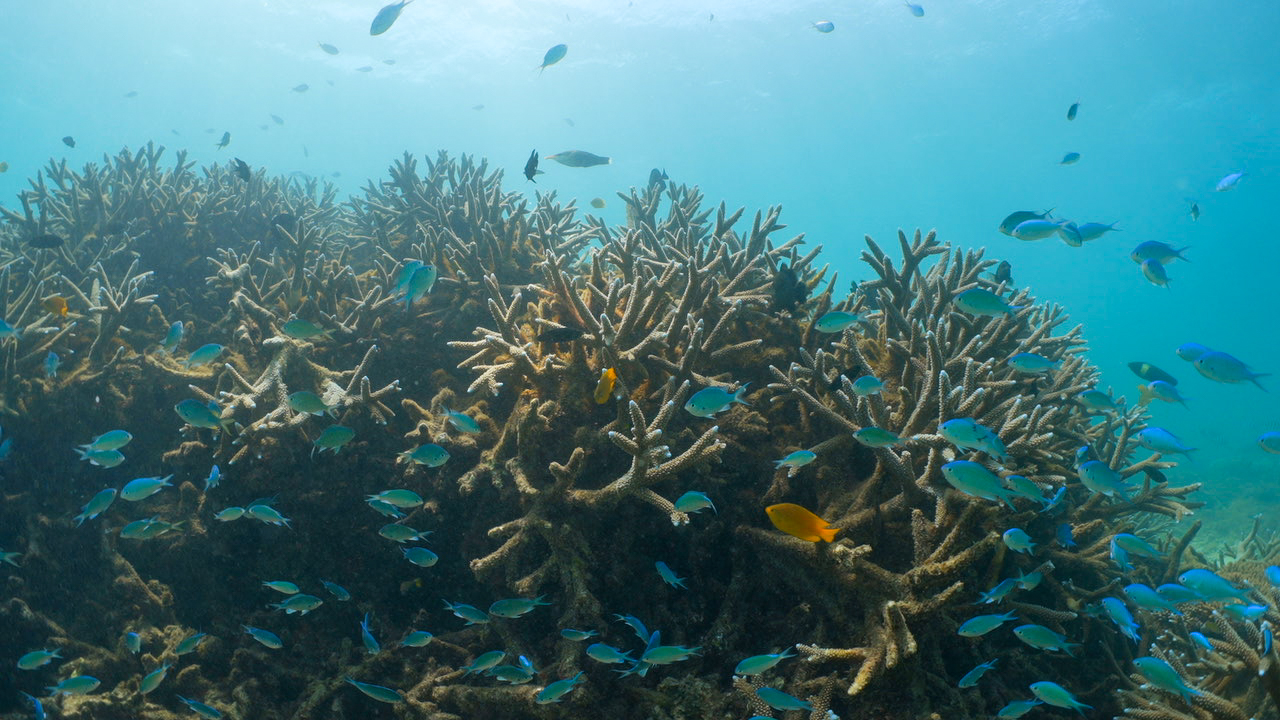
Here in our own backyard at Ningaloo Reef, as in many reefs around the world, these ecosystems are under increasing stress.
While Ningaloo remains one of the most intact reef systems globally, it experienced the most severe marine heatwave on record last year. Coral bleaching and mortality occurred across large areas of the reef.
So why are reefs bleaching?
Coral bleaching occurs when warming ocean temperatures disrupt the relationship between corals and the microscopic algae that live within their tissues.
These algae provide most of the coral’s energy through photosynthesis. When temperatures rise beyond the coral’s tolerance, the algae are lost, leaving the coral white and severely weakened.
Even small temperature increases, just one or two degrees above normal summer conditions for several weeks, can trigger bleaching.
Climate change has dramatically increased the frequency, duration and intensity of marine heatwaves, leaving reefs less time to recover between events.
Strong sunlight during hot periods further increases stress inside coral tissues, accelerating bleaching once temperature thresholds are crossed.
Bleached corals are also more vulnerable to disease and mortality.
When bleaching events occur back-to-back, coral cover declines, reproduction drops and reef structures begin to break down.
Over time, coral-dominated systems can shift toward algae-dominated ones.

So, what can be done to protect the reef?
There is one obvious long-term solution: reducing greenhouse gas emissions.
But scientists are also exploring ways to strengthen reefs while the climate challenge unfolds.
At Minderoo’s Exmouth Research Lab, researchers have been closely watching this year’s coral spawning event — a natural process where corals simultaneously release female and male spawn into the water to reproduce.
For the first time, scientists are also testing whether corals from Exmouth Gulf could help strengthen Ningaloo’s future.
Because the Gulf experiences warmer water temperatures than the reef, some corals there may already possess greater heat tolerance.
By cross breeding these corals with Ningaloo corals, researchers hope to better understand whether this could help support reef resilience in a warming ocean.
Scientists will have a clearer picture of the results in April.
Stay tuned for our upcoming ConTEXT YouTube episode, where we’ll share our latest findings.
Researchers are also working with Taronga Conservation Society Australia to cryopreserve coral larvae for the first time on site, creating a genetic “bank” that may support future restoration efforts.

The window to protect reefs like Ningaloo is still open.
Scientific projections show that warming oceans will continue to push coral ecosystems closer to their limits.
By 2041, Ningaloo could experience severe bleaching twice every decade. Given that the reef can take around ten years to recover from major disturbances, this frequency would exceed its natural recovery capacity.
By 2049, bleaching could occur every year.
Climate change will also bring other pressures, including stronger cyclones, rising sea levels, ocean acidification and increasing air temperatures — all of which will affect the reef, surrounding ecosystems and coastal communities.
The future of Ningaloo therefore depends on the choices made today.
Protecting the reef is not just about safeguarding coral.
It is about protecting biodiversity, regional livelihoods, and Western Australia’s reputation as a global marine leader.
Reefs and oceans can recover if we give them the chance.
That’s why Minderoo is committed to pioneering research that strengthens reef resilience and gives corals the best possible chance to recover.
Because this isn’t just about what we stand to lose. It’s about what we still have time to protect.
Want to stay in the loop?
Subscribe to our newsletter to stay up to date on our Natural Ecosystems, Communities, Gender Equality and Impact Mission work.
By signing up with your email, you agree to Minderoo Foundation’s Privacy Policy.